212.599 Profile im Ranking

Carl Friedrich Gauß

Deutschland · Akademiker · Lebte 1777 bis 1855 · im Alter von 77

Carl Friedrich Gauß wird in 164 Sprachen etwa 3.102 Mal am Tag gelesen.

Ein typischer Tag, 30 Tage bis 23. Oktober 2026

Der mittlere Tag der gezählten Tage, damit eine Nachrichtenwoche ihn nicht verschieben kann. Die Linie darunter zeigt die letzten 398 Tage, ein Punkt pro Tag.

Stimmt etwas nicht?
Vergleichen

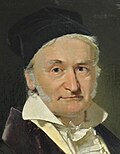
Johann Carl Friedrich Gauß (latinisiert Carolus Fridericus Gauss; * 30. April 1777 in Braunschweig, Fürstentum Braunschweig-Wolfenbüttel; † 23. Februar 1855 in Göttingen, Königreich Hannover) war ein deutscher Mathematiker, Statistiker, Astronom, Geodät, Elektrotechniker und Physiker.

Text aus Wikipedia, CC BY-SA 4.0

Stationen eines Lebens

1855Gestorben23. Februar 18551853Bavarian Maximilian Order for Science and ArtAuszeichnung1842Pour le Mérite for Sciences and Arts orderAuszeichnung1839Honorary Member of the Physics Association (Frankfurt Am Main, Germany)Auszeichnung1838Copley MedalAuszeichnung1832“To praise it would amount to praising myself.”Eigene WorteLetter to Farkas Bolyai, on his son János Bolyai's 1832 publishings on non-Euclidean geometry.

“I will add that I have recently received from Hungary a little paper on non-Euclidean geometry in which I rediscover all my own ideas and results worked out with great elegance...”Eigene WorteLetter to Gerling (1832)

“The history of the apple is too absurd. Whether the apple fell or not, how can any one believe that such a discovery could in that way be accelerated or retarded?”Eigene WorteAs quoted by Robert Chambers, "Sir Isaac Newton and the Apple," The Book of Days (1832) Vol. 2, p. 757.

1827“Less depends upon the choice of words than upon this, that their introduction shall be justified by pregnant theorems.”Eigene Worte"Gauss's Abstract of the Disquisitiones Generales circa Superficies Curvas presented to the Royal Society of Gottingen" (1827) Tr. James

1822Fellow of the American Academy of Arts and SciencesAuszeichnung1809Lalande PrizeAuszeichnung1807“The enchanting charms of this sublime science reveal themselves in all their beauty only to those who have the courage to go deeply into it.”Eigene Worte30. April 1807Letter to Sophie Germain (30 April 1807) ([...]; les charmes enchanteurs de cette sublime science ne se décèlent dans toute leur beauté

1804Fellow of the Royal SocietyAuszeichnung1801“But in our opinion truths of this kind should be drawn from notions rather than from notations.”Eigene WorteAbout the proof of Wilson's theorem. Disquisitiones Arithmeticae (1801) Article 76

1777Geboren30. April 1777

Fotos 8

In ihren eigenen Worten 10
,
Carl Friedrich Gauß
,
10 Aussagen, neueste zuerst
  1. To praise it would amount to praising myself.

    1832, Letter to Farkas Bolyai, on his son János Bolyai's 1832 publishings on non-Euclidean geometry., Eigene Worte

  2. I will add that I have recently received from Hungary a little paper on non-Euclidean geometry in which I rediscover all my own ideas and results worked out with great elegance...

    1832, Letter to Gerling (1832), Eigene Worte

  3. The history of the apple is too absurd. Whether the apple fell or not, how can any one believe that such a discovery could in that way be accelerated or retarded?

    1832, As quoted by Robert Chambers, "Sir Isaac Newton and the Apple," The Book of Days (1832) Vol. 2, p. 757., Eigene Worte

Wikiquote, CC BY-SA 4.0

Auszeichnungen

Bavarian Maximilian Order for Science and Art1853
Pour le Mérite for Sciences and Arts order1842
Honorary Member of the Physics Association (Frankfurt Am Main, Germany)1839
Copley Medal1838
Fellow of the American Academy of Arts and Sciences1822
Lalande Prize1809
Fellow of the Royal Society1804

Familie

Ist das die ganze Familie?

Gezeichnet werden nur Verwandte, die hier ein Profil haben. Eine Familie kann also größer sein als die Zeichnung. Eine Linie kann auch falsch sein.

Diese Familie korrigieren

Zur Person

Johann Carl Friedrich Gauß (latinisiert Carolus Fridericus Gauss; * 30. April 1777 in Braunschweig, Fürstentum Braunschweig-Wolfenbüttel; † 23. Februar 1855 in Göttingen, Königreich Hannover) war ein deutscher Mathematiker, Statistiker, Astronom, Geodät, Elektrotechniker und Physiker. Wegen seiner überragenden wissenschaftlichen Leistungen galt er bereits zu seinen Lebzeiten als Princeps mathematicorum (Fürst der Mathematiker). Seine Tätigkeit erstreckte sich neben der Reinen Mathematik auch auf angewandte Gebiete, zum Beispiel war er mit der Landesvermessung des Königreichs Hannover beauftragt, er erfand zusammen mit Wilhelm Eduard Weber als einer der Ersten elektromagnetische Telegrafie und beide wandten sie als Erste über längere Strecken an, er entwickelte Magnetometer und er initiierte ein weltweites Netz von Stationen zur Erforschung des Erdmagnetismus.

Text aus Wikipedia, CC BY-SA 4.0

Land
Deutschland
Kategorie
Akademiker
Art
Akademiker
Status
verstorben
Daten
Lebte 1777 bis 1855 · im Alter von 77

Fame.am misst Signale öffentlicher Sichtbarkeit. Es misst nicht den Wert eines Menschen, Talent, Moral oder Glaubwürdigkeit.