Dennis Gábor
Vereinigtes Königreich · Wissenschaftler · Lebte 1900 bis 1979 · im Alter von 78
Dennis Gábor wird in 80 Sprachen etwa 125 Mal am Tag gelesen.
Ein typischer Tag, 30 Tage bis 21. Oktober 2026
Der mittlere Tag der gezählten Tage, damit eine Nachrichtenwoche ihn nicht verschieben kann. Die Linie darunter zeigt die letzten 396 Tage, ein Punkt pro Tag.
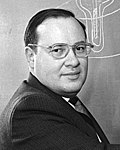
Stimmt etwas nicht?Dennis Gábor (eigentlich Gábor Dénes, deutsch 1920-1934 auch Dionys Gabor) (* 5. Juni 1900 in Budapest; † 8. Februar 1979 in London) war ein ungarischer Ingenieur, der 1971 den Nobelpreis für Physik für die Erfindung der Holografie erhielt.
Text aus Wikipedia, CC BY-SA 4.0
Stationen eines Lebens
Fotos 8


In ihren eigenen Worten 4
 ,
I do not know of anything in modern poetry as violently hostile to contemporary life as was the poetry of T. S.
It would be pleasant to believe that the age of pessimism is now coming to a close, and that its end is marked by the same author who marked its beginning: Aldous Huxley.
The future cannot be predicted, but futures can be invented. It was man's ability to invent which has made human society what it is.
Auszeichnungen
Im Umfeld
Zur Person
Dennis Gábor (eigentlich Gábor Dénes, deutsch 1920-1934 auch Dionys Gabor) (* 5. Juni 1900 in Budapest; † 8. Februar 1979 in London) war ein ungarischer Ingenieur, der 1971 den Nobelpreis für Physik für die Erfindung der Holografie erhielt. Er lebte von 1920 bis 1933 in Deutschland, danach emigrierte er nach England, wo er später die britische Staatsbürgerschaft annahm. Dennis Gábor war Gründungsmitglied des Club of Rome.
Text aus Wikipedia, CC BY-SA 4.0
Gemeinsamkeiten mit Dennis
 Antony HewishBeide ausgezeichnet mit Albert A. Michelson Medal
 Charles H. TownesBeide ausgezeichnet mit Young Medal and Prize
 Martin RyleBeide ausgezeichnet mit Albert A. Michelson Medal
 Claude Cohen-TannoudjiBeide ausgezeichnet mit Young Medal and Prize
 Roy J. GlauberBeide ausgezeichnet mit Albert A. Michelson Medal
 Arthur Leonard SchawlowBeide ausgezeichnet mit Young Medal and Prize
Fame.am misst Signale öffentlicher Sichtbarkeit. Es misst nicht den Wert eines Menschen, Talent, Moral oder Glaubwürdigkeit.