Giovanni Riccioli
Schauspieler · Lebte 1598 bis 1671 · im Alter von 73
Giovanni Riccioli wird in 39 Sprachen etwa 41 Mal am Tag gelesen.
Ein typischer Tag, 30 Tage bis 18. September 2026
Der mittlere Tag der gezählten Tage, damit eine Nachrichtenwoche ihn nicht verschieben kann. Die Linie darunter zeigt die letzten 60 Tage, ein Punkt pro Tag.
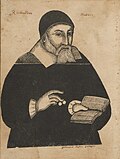
Stimmt etwas nicht?Giovanni Battista Riccioli oder Giambattista Riccioli, latinisiert Johannes Baptista Ricciolus (* 17. April 1598 in Ferrara; † 25. Juni 1671 in Bologna), war ein italienischer Priester (seit 1614 Jesuit) und Astronom.
Text aus Wikipedia, CC BY-SA 4.0
Fotos 7

 The crescent phases of Venus and detailed representations of its appearance as seen through a telescope, from Riccioli's 1651 New Almagest.[6]
 Map of the Moon from the New Almagest.
 Frontispiece of Riccioli's 1651 New Almagest. Mythological figures observe the heavens with a telescope and weigh the heliocentric theory of Copernicus in a balance against his modified version of Tycho Brahe's geo-heliocentric system, in which the Sun, Moon, Jupiter, and Saturn orbit the Earth while Mercury, Venus, and Mars orbit the Sun. The old Ptolemaic geocentric theory lies discarded on the ground, made obsolete by the telescope's discoveries. These are illustrated at top and include phases of Venus and Mercury and a surface feature on Mars (left), moons of Jupiter, rings of Saturn, and features on the Moon (right). The balance tips in favor of Riccioli's "Tychonic" system.
 Illustration from Riccioli's 1651 New Almagest showing the effect a rotating Earth should have on projectiles.[36] When the cannon is fired at eastern target B, cannon and target both travel east at the same speed while the ball is in flight. The ball strikes the target just as it would if the Earth were immobile. When the cannon is fired at northern target E, the target moves more slowly to the east than the cannon and the airborne ball, because the ground moves more slowly at more northern latitudes (the ground hardly moves at all near the pole). Thus the ball follows a curved path over the ground, not a diagonal, and strikes to the east, or right, of the target at G.
 Representations from Riccioli's 1665 Reformed Astronomy of Saturn's changing appearance.[47]
 Geographicae crucis fabrica et usus ad repraesentandam mira facilitate omnem dierum noctiumque ortuum solis et occasum, horarumque omnium varietatem, 1643
Zur Person
Giovanni Battista Riccioli oder Giambattista Riccioli, latinisiert Johannes Baptista Ricciolus (* 17. April 1598 in Ferrara; † 25. Juni 1671 in Bologna), war ein italienischer Priester (seit 1614 Jesuit) und Astronom. Bevor er sich ganz der Astronomie zuwandte, lehrte er viele Jahre an den Universitäten von Parma und Bologna Philosophie und Theologie. Als Astronom war er einer der Pioniere der Selenografie, die später seine Nomenklatur der Mondkrater und -meere großteils übernahm. In seinem Neuen Almagest stellte er der Heliozentrik das Tychonische Weltsystem gegenüber.
Text aus Wikipedia, CC BY-SA 4.0
Schauspieler, geboren in den 1590er-Jahren 5


Fame.am misst Signale öffentlicher Sichtbarkeit. Es misst nicht den Wert eines Menschen, Talent, Moral oder Glaubwürdigkeit.