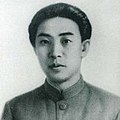
210.809 Profile im Ranking

Kim Il-sung

Nordkorea · Politiker · Lebte 1912 bis 1994 · im Alter von 82 · auch Russland

Häufiger gelesen als sonst, vor allem am 20. Oktober.

Am 20. Oktober 9,1-mal so viele Leser wie sonst. 50.189 Leser am 20. Oktober, vor dem Anstieg etwa 5.491 am Tag.

Vergleichen

Kim Il-sung (auch Kim Il Sung, koreanisch 김일성, nach alter Transkription Kim Ir-sen; * 15. April 1912 als Kim Song-chu in Mankeidai, Chōsen, damals Japanisches Kaiserreich; † 8. Juli 1994 in Pjöngjang, Demokratische Volksrepublik Korea) war ein nordkoreanischer Politiker, der die Chuch’e-Ideologie vertrat und von 1948 bis 1994 der stalinistische Diktator Nordkoreas war.

Text aus Wikipedia, CC BY-SA 4.0

Stationen eines Lebens

1994Gestorben8. Juli 1994“We've always been under sanctions.”Eigene WorteJuni 1994Remarks to Jimmy Carter (June 1994), as recalled during his final policy meeting and featured in the KCTV documentary The Year 1994 of the

1993“Engels once called the British army the most brutal army. During the Second World War, the German fascist army surpassed the barbarism of the British army.”Eigene WorteKim Il-sung to the Swedish communist leader Frank Baude in 1993. Quote and translated fr Mot strömmen, pg. 186: "Engels kallade en gång den

1991“The national assembly of each country, as its highest legislative body, has a mission and responsibility to realise democratic government.”Eigene Worte29. April 1991For a free and peaceful new world, Speech at the opening ceremony of the 85th Inter-parliamentary Conference (April 29, 1991)

1987Order of Klement GottwaldAuszeichnungOrder of Playa GirónAuszeichnungOrder of the Victory of SocialismAuszeichnung1986Order of José MartíAuszeichnung1984Order of Eduardo Mondlane, 1st classAuszeichnung1982Hero of the RepublicAuszeichnung1976“The people are the masters of the revolution in each country. It is like putting a cart before the horse that foreigners carry out the revolution for them.”Eigene WorteQuoted in Kim Il Sung, Master of Leadership (1976) by Takagi Takeo

1973Order of the White LionAuszeichnung1972Ernannt: President of North KoreaAmt28. Dezember 1972 bis 8. Juli 1994Hero of the RepublicAuszeichnung1971Star of the Socialist Republic of RomaniaAuszeichnung1970Jubilee Medal "In Commemoration of the 100th Anniversary of the Birth of Vladimir Ilyich Lenin"Auszeichnung1958Hero of LaborAuszeichnung1955“What is Juche [the subject] in our Party's ideological work? What are we doing? We are not engaged in any other country's revolution, but precisely in the Korean revolution.”Eigene Worte28. Dezember 1955"On eliminating dogmatism and formalism and establishing Juche in ideological work" (28 December 1955), in Works vol. 9

1953Hero of the RepublicAuszeichnungOrder of Freedom and Independence, 1st classAuszeichnung1950Ernannt: Supreme Commander of the Korean People’s ArmyAmt4. Juli 1950 bis 24. Dezember 19911949Ernannt: General Secretary of the Workers' Party of KoreaAmt30. Juni 1949 bis 8. Juli 19941948Ernannt: Premier of North KoreaAmt9. September 1948 bis 28. Dezember 1972Ernannt: Supreme Leader of North KoreaAmt9. September 1948 bis 8. Juli 19941945“The time has come when we Korean people have to unite our strength to build a new, democratic Korea.”Eigene Worte14. Oktober 1945Victory speech in Pyongyang (14 October 1945), in Works vol. 1

Order of the Red BannerAuszeichnung1912Geboren15. April 1912

Fotos 8

In ihren eigenen Worten 10

,
Kim Il-sung
,
10 Aussagen, neueste zuerst
  1. We've always been under sanctions.

    Juni 1994, Remarks to Jimmy Carter (June 1994), as recalled during his final policy meeting and featured in the KCTV documentary The Year 1994 of the, Eigene Worte

  2. Engels once called the British army the most brutal army. During the Second World War, the German fascist army surpassed the barbarism of the British army.

    1993, Kim Il-sung to the Swedish communist leader Frank Baude in 1993. Quote and translated fr Mot strömmen, pg. 186: "Engels kallade en gång den, Eigene Worte

  3. The national assembly of each country, as its highest legislative body, has a mission and responsibility to realise democratic government.

    29. Apr. 1991, For a free and peaceful new world, Speech at the opening ceremony of the 85th Inter-parliamentary Conference (April 29, 1991), Eigene Worte

Wikiquote, CC BY-SA 4.0

Auszeichnungen

Order of Klement Gottwald1987
Order of the Victory of Socialism1987
Order of Playa Girón1987
Order of José Martí1986
Order of Eduardo Mondlane, 1st class1984
Hero of the Republic1982
Order of the White Lion1973
Hero of the Republic1972
Order of Lenin1972
Star of the Socialist Republic of Romania1971
Jubilee Medal "In Commemoration of the 100th Anniversary of the Birth of Vladimir Ilyich Lenin"1970
Hero of Labor1958
Hero of the Republic1953
Order of Freedom and Independence, 1st class1953
Order of the Red Banner1945
Order of Karl Marx
Order of Augusto César Sandino
Order of the National Flag
Order of Sukhbaatar
Order of the Tribute to the Republic
Order of the Yugoslavian Great Star
Grand Cross of the National Order of Mali
Star of the Republic of Indonesia
Grand Cross of the Royal Order of Cambodia
National Order of Madagascar
Order of the Yugoslav Star
Order of Mono
Grand Cross of the Order of Polonia Restituta

Familie

Ist das die ganze Familie?

Gezeichnet werden nur Verwandte, die hier ein Profil haben. Eine Familie kann also größer sein als die Zeichnung. Eine Linie kann auch falsch sein.

Diese Familie korrigieren

Zur Person

Kim Il-sung (auch Kim Il Sung, koreanisch 김일성, nach alter Transkription Kim Ir-sen; * 15. April 1912 als Kim Song-chu in Mankeidai, Chōsen, damals Japanisches Kaiserreich; † 8. Juli 1994 in Pjöngjang, Demokratische Volksrepublik Korea) war ein nordkoreanischer Politiker, der die Chuch’e-Ideologie vertrat und von 1948 bis 1994 der stalinistische Diktator Nordkoreas war. Als „Ewiger Präsident“ gilt er über den Tod hinaus als De-jure-Staatschef Nordkoreas. In der nordkoreanischen Propaganda wird er als der „Große Führer Genosse Kim Il-sung“ (위대한수령김일성동지 Widaehan Suryŏng Kim Il Sŏng Tongji) bezeichnet. Nach seinem Tod wurde sein Sohn Kim Jong-il oberster Machthaber Nordkoreas. Dieser verstarb 2011 und wurde von seinem Sohn Kim Jong-un als Staatschef beerbt. Teilweise wird daher bei der Familie Kim von der ersten „kommunistischen Dynastie“ gesprochen.

Text aus Wikipedia, CC BY-SA 4.0

Land
Nordkorea
Kategorie
Politiker
Art
Politiker
Status
verstorben
Daten
Lebte 1912 bis 1994 · im Alter von 82

Fame.am misst Signale öffentlicher Sichtbarkeit. Es misst nicht den Wert eines Menschen, Talent, Moral oder Glaubwürdigkeit.