Mustafa Kemal Atatürk wird in 210 Sprachen etwa 8.325 Mal am Tag gelesen.
Ein typischer Tag, 30 Tage bis 23. Oktober 2026
Der mittlere Tag der gezählten Tage, damit eine Nachrichtenwoche ihn nicht verschieben kann. Die Linie darunter zeigt die letzten 398 Tage, ein Punkt pro Tag.
Stimmt etwas nicht?Kemal Atatürk (bis 1934 Mustafa Kemal Pascha, osmanisch مصطفى كمال پاشا Muṣṭafâ Kemâl Paşa; von 1935 bis 1937 Kamâl Atatürk; * 1881 in Selânik, Osmanisches Reich (heute Thessaloniki, Griechenland); † 10. November 1938 in Istanbul, Türkei), auch als Mustafa Kemal Atatürk bezeichnet, war der Begründer der Republik...
Text aus Wikipedia, CC BY-SA 4.0
Stationen eines Lebens
Fotos 12


 The house where Atatürk was born in the Ottoman city of Salonica, now a museum
 Atatürk's identity document with serial number 993 814
 Mustafa Kemal on the day of graduation from the War Academy in 1905
 Mustafa Kemal (front row, second from left) with the Ottoman Turkish observers at the Picardie army manoeuvres in France, 28 September 1910
 Mustafa Kemal (left) with an Ottoman military officer and Bedouin forces in Derna, Tripolitania Vilayet, 1912
 Cevat Pasha and Mustafa Kemal on the daily Tasvîr-i Efkâr dated 29 October 1915
In ihren eigenen Worten 10
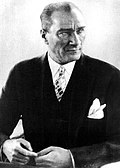 ,
Today the Soviet Union is a friend and an ally. We need this friendship. However, no one can know what will happen tomorrow.
...O Turkish child of future generations! As you see, even under these circumstances and conditions, it is your duty to save the Turkish Independence and the Republic!
Our object now is to strengthen the ties that bind us to other nations.
Auszeichnungen
Familie
Eltern

 Mustafa Kemal Atatürk
Partner

Kinder


Ist das die ganze Familie?
Gezeichnet werden nur Verwandte, die hier ein Profil haben. Eine Familie kann also größer sein als die Zeichnung. Eine Linie kann auch falsch sein.
Diese Familie korrigierenZur Person
Kemal Atatürk (bis 1934 Mustafa Kemal Pascha, osmanisch مصطفى كمال پاشا Muṣṭafâ Kemâl Paşa; von 1935 bis 1937 Kamâl Atatürk; * 1881 in Selânik, Osmanisches Reich (heute Thessaloniki, Griechenland); † 10. November 1938 in Istanbul, Türkei), auch als Mustafa Kemal Atatürk bezeichnet, war der Begründer der Republik Türkei und von 1923 bis 1938 erster Präsident der nach dem Ersten Weltkrieg aus dem Osmanischen Reich hervorgegangenen modernen Republik. Seine Verdienste als Offizier bei der Verteidigung der Halbinsel Gallipoli 1915 gegen alliierte Truppen, die die Dardanellen unter ihre Kontrolle bringen wollten, und ab 1921 der Abwehrkampf gegen die nach Anatolien vorgedrungenen Griechen ließen ihn zur Symbolfigur türkischen Selbstbehauptungswillens und Nationalbewusstseins werden. Als Machtpolitiker, der die Modernisierung seines Landes nach westlichem Vorbild beharrlich vorantrieb, schuf er mit der Abschaffung von Sultanat und Kalifat sowie mit weitreichenden gesellschaftlichen Reformen (Einführung des Laizismus, Gleichstellung von Mann und Frau, Türkisierung des Landes etc.) einen in dieser Form einmaligen Staatstypus. Darauf beruhen - trotz teilweiser Kontroversen über sein Wirken - die personenkultartige Verehrung, die ihm in der Türkei bis heute entgegengebracht wird, und die Unangefochtenheit des ihm 1934 vom türkischen Parlament verliehenen Nachnamens Atatürk (Vater der Türken).
Text aus Wikipedia, CC BY-SA 4.0
Gemeinsamkeiten mit Mustafa


Politiker aus der Türkei 3


Fame.am misst Signale öffentlicher Sichtbarkeit. Es misst nicht den Wert eines Menschen, Talent, Moral oder Glaubwürdigkeit.