Niccolò Machiavelli
Politiker · Lebte 1469 bis 1527 · im Alter von 58
Niccolò Machiavelli wird in 159 Sprachen etwa 7.115 Mal am Tag gelesen.
Ein typischer Tag, 30 Tage bis 23. Oktober 2026
Der mittlere Tag der gezählten Tage, damit eine Nachrichtenwoche ihn nicht verschieben kann. Die Linie darunter zeigt die letzten 398 Tage, ein Punkt pro Tag.
Stimmt etwas nicht?Niccolò di Bernardo dei Machiavelli [nikːoˈlɔ makjaˈvɛlːi] (* 3. Mai 1469 in Florenz, Republik Florenz; † 21. Juni 1527 ebenda) war ein italienischer Philosoph, Diplomat, Chronist, Schriftsteller und Dichter.
Text aus Wikipedia, CC BY-SA 4.0
Stationen eines Lebens
Fotos 11

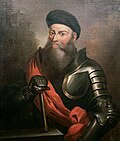
 Oil painting of Machiavelli by Cristofano dell'Altissimo
 Machiavelli's tomb in the Santa Croce Church in Florence
 Lorenzo di Piero de' Medici, to whom the final version of The Prince was dedicated
 Engraved portrait of Machiavelli, from the Peace Palace Library's Il Principe, published in 1769
 Xenophon, author of the Cyropedia
 Statue at the Uffizi
 Francis Bacon argued the case for what would become modern science which would be based more upon real experience and experimentation, free from assumptions about metaphysics, and aimed at increasing control of nature. He named Machiavelli as a predecessor.
In ihren eigenen Worten 10
 ,
, Men never do good unless necessity drives them to it; but when they are free to choose and can do just as they please, confusion and disorder become rampant.
So in all human affairs one notices, if one examines them closely, that it is impossible to remove one inconvenience without another emerging.
It was the verdict of ancient writers that men afflict themselves in evil and weary themselves in the good, and that the same effects result from both of these passions.
Familie
Eltern
Niccolò MachiavelliPartner
Kinder
Ist das die ganze Familie?
Gezeichnet werden nur Verwandte, die hier ein Profil haben. Eine Familie kann also größer sein als die Zeichnung. Eine Linie kann auch falsch sein.
Diese Familie korrigierenZur Person
Niccolò di Bernardo dei Machiavelli [nikːoˈlɔ makjaˈvɛlːi] (* 3. Mai 1469 in Florenz, Republik Florenz; † 21. Juni 1527 ebenda) war ein italienischer Philosoph, Diplomat, Chronist, Schriftsteller und Dichter. Vor allem aufgrund seiner beiden Werke Il Principe (Der Fürst) und I Discorsi sopra la prima deca di Tito Livio (Discorsi) gilt er als einer der bedeutendsten Staatsphilosophen der Neuzeit. Machiavelli ging es in seinen Werken darum, Macht analytisch zu untersuchen und die Differenz zwischen dem, was sein soll, und dem, was ist, festzustellen. Er orientierte sich in seiner Analyse an dem, was er für empirisch feststellbar hielt. Der Fürst spielte eine wesentliche Rolle in den Debatten um den Machiavellismus. Der später geprägte Begriff Machiavellismus wird oft als abwertende Beschreibung eines Verhaltens gebraucht, das zwar raffiniert, aber ohne ethische Einflüsse von Moral und Sittlichkeit die eigene Macht und das eigene Wohl als Ziel sieht. Das für Machiavelli selbst sehr wichtige Werk Dell’arte della guerra (Über die Kriegskunst) wird dagegen weniger rezipiert.
Text aus Wikipedia, CC BY-SA 4.0
Politiker, geboren in den 1460er-Jahren 6




Fame.am misst Signale öffentlicher Sichtbarkeit. Es misst nicht den Wert eines Menschen, Talent, Moral oder Glaubwürdigkeit.