Paul Erdős
Ungarn · Akademiker · Lebte 1913 bis 1996 · im Alter von 83
Paul Erdős wird in 68 Sprachen etwa 1.092 Mal am Tag gelesen.
Ein typischer Tag, 30 Tage bis 22. Oktober 2026
Der mittlere Tag der gezählten Tage, damit eine Nachrichtenwoche ihn nicht verschieben kann. Die Linie darunter zeigt die letzten 397 Tage, ein Punkt pro Tag.
Stimmt etwas nicht?Paul Erdős [ˈɛrdøːʃ] (ungarisch Erdős Pál; geboren am 26. März 1913 in Budapest, Österreich-Ungarn; gestorben am 20. September 1996 in Warschau, Polen) war ein ungarischer Mathematiker. Paul Erdős arbeitete mit hunderten von Kollegen auf den Gebieten Kombinatorik, Graphentheorie und Zahlentheorie zusammen.
Text aus Wikipedia, CC BY-SA 4.0
Stationen eines Lebens
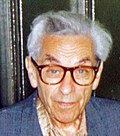
Fotos 8


In ihren eigenen Worten 10
 ,
Television is something the Russians invented to destroy American education.
Another roof, another proof.
Suppose aliens invade the earth and threaten to obliterate it in a year's time unless human beings can find the Ramsey number for red five and blue five.
Auszeichnungen
Im Umfeld
Zur Person
Paul Erdős [ˈɛrdøːʃ] (ungarisch Erdős Pál; geboren am 26. März 1913 in Budapest, Österreich-Ungarn; gestorben am 20. September 1996 in Warschau, Polen) war ein ungarischer Mathematiker. Paul Erdős arbeitete mit hunderten von Kollegen auf den Gebieten Kombinatorik, Graphentheorie und Zahlentheorie zusammen. Er ist im Zusammenhang mit der Erdős-Zahl bekannt. Von ihm stammt außerdem die Idee zu dem BUCH, in dem Gott die perfekten Beweise für mathematische Sätze aufbewahrt. Ein Versuch, diesem Buch nahezukommen, stellt Das Buch der Beweise von Aigner und Ziegler dar, das 1998 veröffentlicht wurde und an dem er vor seinem Tod noch mitwirkte.
Text aus Wikipedia, CC BY-SA 4.0
Gemeinsamkeiten mit Paul
 Andrey KolmogorovBeide ausgezeichnet mit Wolf Prize in Mathematics
 Andrew WilesBeide ausgezeichnet mit Cole Prize in Number Theory
 Jean-Pierre SerreBeide ausgezeichnet mit Wolf Prize in Mathematics
 Manjul BhargavaBeide ausgezeichnet mit Cole Prize in Number Theory
 Yitang ZhangBeide ausgezeichnet mit Cole Prize in Number Theory
Akademiker aus Ungarn 1

Fame.am misst Signale öffentlicher Sichtbarkeit. Es misst nicht den Wert eines Menschen, Talent, Moral oder Glaubwürdigkeit.