211.805 Profile im Ranking

Philip Warren Anderson

Vereinigte Staaten · Wissenschaftler · Lebte 1923 bis 2020 · im Alter von 96

Philip Warren Anderson wird in 68 Sprachen etwa 93 Mal am Tag gelesen.

Ein typischer Tag, 30 Tage bis 16. September 2026

Der mittlere Tag der gezählten Tage, damit eine Nachrichtenwoche ihn nicht verschieben kann. Die Linie darunter zeigt die letzten 361 Tage, ein Punkt pro Tag.

Stimmt etwas nicht?
Vergleichen

Philip Warren Anderson (* 13. Dezember 1923 in Indianapolis, Indiana; † 29. März 2020 in Princeton, New Jersey) war ein US-amerikanischer theoretischer Physiker.

Text aus Wikipedia, CC BY-SA 4.0

Stationen eines Lebens

2020Gestorben29. März 20202011“Of course I am not religious - I don’t in fact see how any scientist who thinks at all deeply can be so ...”Eigene Wortep. 133

“All I can say to the younger theorists is: don’t trust anyone over 45, except maybe me, and I’m not so sure about me.”Eigene Wortep. 159, quoted by N. David Mermin in cite journal|title=Review of More and Different: Notes from a Thoughtful Curmudgeon by Philip W.

“We atheists can . . . argue that, with the modern revolution in attitudes toward homosexuals, we have become the only group that may not reveal itself in normal social discourse”.”Eigene Wortep. 177

2007Honorary Doctor of the Tsinghua UniversityAuszeichnung2005“My belief is based on the fact that string theory is the first science in hundreds of years to be pursued in pre-Baconian fashion, without any adequate experimental guidance.”Eigene Worte4. Januar 2005cite news| publisher=New York Times| date=2005-01-04| title=

1997John Bardeen PrizeAuszeichnung1994Honorary Doctorate from ENSAuszeichnung1982National Medal of ScienceAuszeichnung1980Foreign Member of the Royal SocietyAuszeichnung1978Guthrie Medal and PrizeAuszeichnung1977Nobel Prize in PhysicsAuszeichnung1975Dannie Heineman PrizeAuszeichnung1972“The behavior of large and complex aggregates of elementary particles, it turns out, is not to be understood in terms of a simple extrapolation of a few particles.”Eigene Wortep. 393 of

“... the state of a really big system does not at all have to have the symmetry of the laws which govern it; in fact, it usually has less symmetry.”Eigene Wortep. 395

1964Oliver E. Buckley Condensed Matter PrizeAuszeichnung1923Geboren13. Dezember 1923

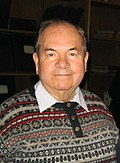
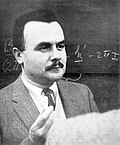
Fotos 5

In ihren eigenen Worten 10

,
Philip Warren Anderson
,
10 Aussagen, neueste zuerst
  1. That Big Science culture in the USA, and similar groups elswhere, tended to have separate, direct access to government and hence to funding sources.

    2011, p. 94, Eigene Worte

  2. Of course I am not religious - I don’t in fact see how any scientist who thinks at all deeply can be so ...

    2011, p. 133, Eigene Worte

  3. All I can say to the younger theorists is: don’t trust anyone over 45, except maybe me, and I’m not so sure about me.

    2011, p. 159, quoted by N. David Mermin in cite journal|title=Review of More and Different: Notes from a Thoughtful Curmudgeon by Philip W., Eigene Worte

Wikiquote, CC BY-SA 4.0

Auszeichnungen

Honorary Doctor of the Tsinghua University2007
John Bardeen Prize1997
Honorary Doctorate from ENS1994
National Medal of Science1982
Foreign Member of the Royal Society1980
Guthrie Medal and Prize1978
Nobel Prize in Physics1977
Dannie Heineman Prize1975
Oliver E. Buckley Condensed Matter Prize1964
Harvard Centennial Medal
Fellow of the American Academy of Arts and Sciences

Zur Person

Philip Warren Anderson (* 13. Dezember 1923 in Indianapolis, Indiana; † 29. März 2020 in Princeton, New Jersey) war ein US-amerikanischer theoretischer Physiker. Er erhielt 1977 zusammen mit Nevill F. Mott und John H. Van Vleck den Nobelpreis für Physik „für die grundlegenden theoretischen Leistungen zur Elektronenstruktur in magnetischen und ungeordneten Systemen“.

Text aus Wikipedia, CC BY-SA 4.0

Land
Vereinigte Staaten
Kategorie
Wissenschaftler
Art
Wissenschaftler
Status
verstorben
Daten
Lebte 1923 bis 2020 · im Alter von 96

Fame.am misst Signale öffentlicher Sichtbarkeit. Es misst nicht den Wert eines Menschen, Talent, Moral oder Glaubwürdigkeit.