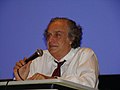
212.599 Profile im Ranking

Ray Kurzweil

Vereinigte Staaten · Wissenschaftler · Geboren 1948 · Alter 78

Ray Kurzweil wird in 45 Sprachen etwa 1.093 Mal am Tag gelesen.

Ein typischer Tag, 30 Tage bis 22. Oktober 2026

Der mittlere Tag der gezählten Tage, damit eine Nachrichtenwoche ihn nicht verschieben kann. Die Linie darunter zeigt die letzten 397 Tage, ein Punkt pro Tag.

Stimmt etwas nicht?

Raymond „Ray“ Kurzweil [ˈkɜrzwaɪl] (* 12. Februar 1948 in Queens, New York City) ist ein US-amerikanischer Autor, Erfinder, Futurist und Leiter der technischen Entwicklung (Director of Engineering) bei Google LLC.

Text aus Wikipedia, CC BY-SA 4.0

Stationen eines Lebens

2011“Creating an avatar of this sort is one way of embodying that information in a way that human beings can interact with. It is inherently human to transcend limitations.”Eigene Worte9. August 2011Futurist Ray Kurzweil Bring Dead Father Back to Life (August 9, 2011)

“I will be able to talk to this re-creation. Ultimately, it will be so realistic it will be like talking to my father.”Eigene WorteFuturist Ray Kurzweil Bring Dead Father Back to Life (2011)

“I think all human beings are and should be fearful [of death, but realizing that death is a real tragedy.”Eigene WorteFuturist Ray Kurzweil Bring Dead Father Back to Life (2011)

“The Terminator' is not an impossibility. I think that symbolizes the downside of artificial intelligence ... but technology has a big downside in general.”Eigene WorteFuturist Ray Kurzweil Bring Dead Father Back to Life (2011)

2005“My spiritual education...took place at a Unitarian Church...The theme was "many paths to the truth." …even the inconsistencies were illuminating.”Eigene Wortep. 1

“This, then, was the religion that I was raised with: veneration for human creativity and the power of ideas.”Eigene Wortep. 2

2004Migel MedalAuszeichnung2002National Inventors Hall of FameAuszeichnung2001Lemelson-MIT PrizeAuszeichnung1999National Medal of Technology and InnovationAuszeichnung1995Dickson Prize in ScienceAuszeichnung1994ACM FellowAuszeichnung1978Grace Murray Hopper AwardAuszeichnung1948Geboren12. Februar 1948

Fotos 2

In ihren eigenen Worten 10

,
Ray Kurzweil
,
10 Aussagen, neueste zuerst
  1. Creating an avatar of this sort is one way of embodying that information in a way that human beings can interact with. It is inherently human to transcend limitations.

    9. Aug. 2011, Futurist Ray Kurzweil Bring Dead Father Back to Life (August 9, 2011), Eigene Worte

  2. I will be able to talk to this re-creation. Ultimately, it will be so realistic it will be like talking to my father.

    2011, Futurist Ray Kurzweil Bring Dead Father Back to Life (2011), Eigene Worte

  3. You can certainly argue that, philosophically, that is not your father.

    2011, Futurist Ray Kurzweil Bring Dead Father Back to Life (2011), Eigene Worte

Wikiquote, CC BY-SA 4.0

Auszeichnungen

Migel Medal2004
National Inventors Hall of Fame2002
Lemelson-MIT Prize2001
National Medal of Technology and Innovation1999
Dickson Prize in Science1995
ACM Fellow1994
Grace Murray Hopper Award1978
Dickson Prize

Im Umfeld

Kind: Amy Kurzweil

Zur Person

Raymond „Ray“ Kurzweil [ˈkɜrzwaɪl] (* 12. Februar 1948 in Queens, New York City) ist ein US-amerikanischer Autor, Erfinder, Futurist und Leiter der technischen Entwicklung (Director of Engineering) bei Google LLC. Er gilt als Pionier der optischen Texterkennung (engl. optical character recognition, OCR), Sprachsynthese (computervorgelesene Texte), Spracherkennung, Flachbettscannertechnologie und im Bereich elektronischer Musikinstrumente, insbesondere der Keyboards. Als bekannter Sachbuchautor schreibt er u. a. über Gesundheitstechnologie, künstliche Intelligenz (KI), Transhumanismus, die technologische Singularität und Zukunftsforschung. Außerdem gilt er als der berühmteste Vertreter des technologischen Posthumanismus.

Text aus Wikipedia, CC BY-SA 4.0

Land
Vereinigte Staaten
Kategorie
Wissenschaftler
Art
Wissenschaftler
Status
lebend
Daten
Geboren 1948 · Alter 78

Fame.am misst Signale öffentlicher Sichtbarkeit. Es misst nicht den Wert eines Menschen, Talent, Moral oder Glaubwürdigkeit.