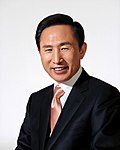
213.219 Profile im Ranking

Roh Moo-hyun

Südkorea · Politiker · Lebte 1946 bis 2009 · im Alter von 62

Roh Moo-hyun wird in 78 Sprachen etwa 999 Mal am Tag gelesen.

Ein typischer Tag, 30 Tage bis 23. Oktober 2026

Der mittlere Tag der gezählten Tage, damit eine Nachrichtenwoche ihn nicht verschieben kann. Die Linie darunter zeigt die letzten 398 Tage, ein Punkt pro Tag.

Stimmt etwas nicht?
Vergleichen

Roh Moo-hyun ( * 1. September 1946 in Gimhae, Provinz Gyeongsangnam; † 23. Mai 2009 in Busan, Provinz Gyeongsangnam) war ein südkoreanischer Politiker. Er war vom 25. Februar 2003 bis zum 25. Februar 2008 Präsident der Republik Korea. Bevor er in die Politik ging, war er Anwalt für Menschenrechte.

Text aus Wikipedia, CC BY-SA 4.0

Stationen eines Lebens

2009Gestorben23. Mai 20092007“I have believed for a long time that North Korea was willing to give up nuclear weapons, and there is no change in my belief.”Eigene Worte10. Dezember 2007CNN, 10 December 2007

“In Korea, to step down from the presidency is to step down from politics. But I thought about what it means to step down. I hope that means a free man.”Eigene Worte10. Dezember 2007CNN, 10 December 2007

Collar of the Spanish Order of the Civil MeritAuszeichnungKnight of the Order of the ElephantAuszeichnung2004Order of the White Eagle (Third Polish Republic)Auszeichnung2003“It is unpredictable what course of action North Korea will take in the coming days, but no government has a policy that can never be changed. They can never be unchanged.”Eigene Worte15. Mai 2003PBS, 15 May 2003

“Fellow citizens. Historically, we Koreans have lived through a series of challenges and have responded to them.”Eigene Worte25. Februar 2003Excerpts from inaugural address (25 February 2003)

“The Korean Peninsula is located at the heart of the region. It is a big bridge linking China and Japan, the continent and the ocean.”Eigene Worte25. Februar 2003Excerpts from inaugural address (25 February 2003)

“We must build strength and maintain vision. That requires inexorable efforts for reform and integration.”Eigene Worte25. Februar 2003Excerpts from inaugural address (25 February 2003)

1946Geboren1. September 1946

Fotos 8

In ihren eigenen Worten 10

,
Roh Moo-hyun
,
10 Aussagen, neueste zuerst
  1. I have believed for a long time that North Korea was willing to give up nuclear weapons, and there is no change in my belief.

    10. Dez. 2007, CNN, 10 December 2007, Eigene Worte

  2. Korea-U.S. relations were important in the past and will be important in the future. We have had dark moments in our relationship and times when we needed very close cooperation.

    10. Dez. 2007, CNN, 10 December 2007, Eigene Worte

  3. In Korea, to step down from the presidency is to step down from politics. But I thought about what it means to step down. I hope that means a free man.

    10. Dez. 2007, CNN, 10 December 2007, Eigene Worte

Wikiquote, CC BY-SA 4.0

Auszeichnungen

Knight of the Order of the Elephant2007
Collar of the Spanish Order of the Civil Merit2007
Order of the White Eagle (Third Polish Republic)2004
Knight Grand Cross of the Order of the Bath
Grand Order of Mugunghwa
National Order of Merit
Order of Independence
Order of the Bath
Order of Civil Merit

Familie

Ist das die ganze Familie?

Gezeichnet werden nur Verwandte, die hier ein Profil haben. Eine Familie kann also größer sein als die Zeichnung. Eine Linie kann auch falsch sein.

Diese Familie korrigieren

Zur Person

Roh Moo-hyun ( * 1. September 1946 in Gimhae, Provinz Gyeongsangnam; † 23. Mai 2009 in Busan, Provinz Gyeongsangnam) war ein südkoreanischer Politiker. Er war vom 25. Februar 2003 bis zum 25. Februar 2008 Präsident der Republik Korea. Bevor er in die Politik ging, war er Anwalt für Menschenrechte. Er galt als Streiter für Demokratisierung, Menschenrechte und die Armen des Landes. Roh war angetreten, um sich für die Aussöhnung mit Nordkorea einzusetzen.

Text aus Wikipedia, CC BY-SA 4.0

Land
Südkorea
Kategorie
Politiker
Art
Politiker
Status
verstorben
Daten
Lebte 1946 bis 2009 · im Alter von 62

Fame.am misst Signale öffentlicher Sichtbarkeit. Es misst nicht den Wert eines Menschen, Talent, Moral oder Glaubwürdigkeit.