Werner Heisenberg
Deutschland · Wissenschaftler · Lebte 1901 bis 1976 · im Alter von 74
Werner Heisenberg wird in 115 Sprachen etwa 4.293 Mal am Tag gelesen.
Ein typischer Tag, 30 Tage bis 22. Oktober 2026
Der mittlere Tag der gezählten Tage, damit eine Nachrichtenwoche ihn nicht verschieben kann. Die Linie darunter zeigt die letzten 397 Tage, ein Punkt pro Tag.
Stimmt etwas nicht?Werner Karl Heisenberg (* 5. Dezember 1901 in Würzburg; † 1. Februar 1976 in München) war ein deutscher Physiker, der als Begründer der Quantenmechanik gilt und zu den bedeutendsten Physikern des 20. Jahrhunderts zählt. Heisenberg gab 1925 die erste mathematische Formulierung der Quantenmechanik an.
Text aus Wikipedia, CC BY-SA 4.0
Stationen eines Lebens
Fotos 8
 Bundesarchiv Bild183-R57262, Werner Heisenberg
 15. Tagung 1965 Physiker Werner Heisenberg, Karl Georg v. Hevesy, Rudolf L. Mößbauer - W134Nr.078937b - Willy Pragher
 15. Tagung 1965 Physiker; Maikäferrede- Otto Hahn, Werner Heisenberg, Richard Kuhn, hinten- Sir John D. Cockcroft - LABW - Staatsarchiv Freiburg W 134 Nr. 078969
 15. Tagung 1965 Physiker; Maikäferrede- Werner Heisenberg, Richard Kuhn - LABW - Staatsarchiv Freiburg W 134 Nr. 078962
 15. Tagung 1965 Physiker; Maikäferrede- Werner Heisenberg, Rudolf L. Mößbauer - LABW - Staatsarchiv Freiburg W 134 Nr. 078954a
 Heisenberg,Werner 1924 Göttingen
 Heisenberg,Werner 1926
 Heisenberg 10
In ihren eigenen Worten 10
 ,
In general, scientific progress calls for no more than the absorption and elaboration of new ideas - and this is a call most scientists are happy to heed.
The problem of values is nothing but the problem of our acts, goals and morals.
Light and matter are both single entities, and the apparent duality arises in the limitations of our language.
Auszeichnungen
Familie
Eltern
Werner HeisenbergPartner
Kinder

Ist das die ganze Familie?
Gezeichnet werden nur Verwandte, die hier ein Profil haben. Eine Familie kann also größer sein als die Zeichnung. Eine Linie kann auch falsch sein.
Diese Familie korrigierenZur Person
Werner Karl Heisenberg (* 5. Dezember 1901 in Würzburg; † 1. Februar 1976 in München) war ein deutscher Physiker, der als Begründer der Quantenmechanik gilt und zu den bedeutendsten Physikern des 20. Jahrhunderts zählt. Heisenberg gab 1925 die erste mathematische Formulierung der Quantenmechanik an. 1927 formulierte er die Heisenbergsche Unschärferelation, ein fundamentales Prinzip der Quantenmechanik. Für die Begründung der Quantenmechanik wurde er 1933 mit dem Nobelpreis für Physik des Jahres 1932 ausgezeichnet. Er befasste sich auch mit den philosophischen Aspekten der Quantenmechanik und äußerte sich in umstrittener Weise zur Entwicklung und Anwendung der Atombombe. Nach dem Studium in München war Heisenberg Assistent von Max Born in Göttingen und arbeitete in Niels Bohrs Institut in Kopenhagen. Ab 1927 lehrte er Physik in Leipzig und ab 1942 in Berlin, wo er zugleich das Kaiser-Wilhelm-Institut für Physik leitete. Während des Zweiten Weltkriegs war er am deutschen Uranprojekt beteiligt. Nach dem Krieg war er Direktor des Max-Planck-Instituts für Physik in Göttingen (1946-1958) und München (1958-1970).
Text aus Wikipedia, CC BY-SA 4.0
Gemeinsamkeiten mit Werner
 Richard FeynmanBeide ausgezeichnet mit Niels Bohr International Gold Medal
 Erwin SchrödingerBeide ausgezeichnet mit Max Planck Medal
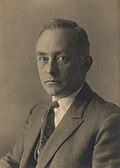 Max BornBeide ausgezeichnet mit Max Planck Medal
 Guglielmo MarconiBeide ausgezeichnet mit Matteucci Medal
 Pyotr KapitsaBeide ausgezeichnet mit Niels Bohr International Gold Medal
Wissenschaftler aus Deutschland 1

Fame.am misst Signale öffentlicher Sichtbarkeit. Es misst nicht den Wert eines Menschen, Talent, Moral oder Glaubwürdigkeit.