212.599 Profile im Ranking

John Herschel

Vereinigtes Königreich · Akademiker · Lebte 1792 bis 1871 · im Alter von 79

John Herschel wird in 77 Sprachen etwa 299 Mal am Tag gelesen.

Ein typischer Tag, 30 Tage bis 22. Oktober 2026

Der mittlere Tag der gezählten Tage, damit eine Nachrichtenwoche ihn nicht verschieben kann. Die Linie darunter zeigt die letzten 397 Tage, ein Punkt pro Tag.

Stimmt etwas nicht?
Vergleichen

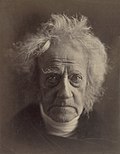
Sir John Frederick William Herschel, 1. Baronet (* 7. März 1792 in Slough, Buckinghamshire (heute Berkshire); † 11. Mai 1871 in Hawkhurst, Kent) war ein britischer Astronom und Sohn des Uranus-Entdeckers Wilhelm Herschel.

Text aus Wikipedia, CC BY-SA 4.0

Stationen eines Lebens

1871Gestorben11. Mai 18711855“What God sends is welcome.”Eigene WorteNovember 1855Diary entry (November 1855), as quoted in The Shadow of the Telescope: A Biography of John Herschel by Günther Buttmann

1850Ernannt: Master of the MintAmt1. Januar 1850 bis 1. Januar 18551847Ernannt: President of the Royal Astronomical SocietyAmt1. Januar 1827 bis 1. Januar 1829Copley MedalAuszeichnung1845Ernannt: President of the British Science AssociationAmt1. Januar 1845 bis 1. Januar 18461842Ernannt: Rector of Marischal College, AberdeenAmt1. Januar 1842 bis 1. Januar 18431839Ernannt: President of the Royal Astronomical SocietyAmt1. Januar 1827 bis 1. Januar 18291833Royal MedalAuszeichnung1832Fellow of the American Academy of Arts and SciencesAuszeichnung1831“We must never forget that it is principles, not phenomena, - laws not insulated independent facts, - which are the objects of inquiry to the natural philosopher.”Eigene WorteA Preliminary Discourse on the Study of Natural Philosophy (1831)

“To ascend to the origin of things and speculate on the creation, is not the business of the natural philosopher.”Eigene WorteAccustomed to trace the operation of general causes, and the exemplification of general laws, in circumstances where the uninformed and

“Science is the knowledge of many, orderly and methodically digested and arranged, so as to become attainable by one.”Eigene WorteAccustomed to trace the operation of general causes, and the exemplification of general laws, in circumstances where the uninformed and

“The question "cui bono" to what practical end and advantage do your researches tend?”Eigene WorteAccustomed to trace the operation of general causes, and the exemplification of general laws, in circumstances where the uninformed and

1828“Of the splendid constellation of great names...”Eigene WorteOn the Theory of Light (1828) p.494

1827Ernannt: President of the Royal Astronomical SocietyAmt1. Januar 1827 bis 1. Januar 18291826Gold Medal of the Royal Astronomical SocietyAuszeichnung1825Lalande PrizeAuszeichnung1823Royal Society Bakerian MedalAuszeichnung1821Copley MedalAuszeichnung1813Fellow of the Royal SocietyAuszeichnung1792Geboren7. März 1792

Fotos 8

In ihren eigenen Worten 8

,
John Herschel
,
8 Aussagen, neueste zuerst
  1. What God sends is welcome.

    Nov. 1855, Diary entry (November 1855), as quoted in The Shadow of the Telescope: A Biography of John Herschel by Günther Buttmann, Eigene Worte

  2. We must never forget that it is principles, not phenomena, - laws not insulated independent facts, - which are the objects of inquiry to the natural philosopher.

    1831, A Preliminary Discourse on the Study of Natural Philosophy (1831), Eigene Worte

  3. To ascend to the origin of things and speculate on the creation, is not the business of the natural philosopher.

    1831, Accustomed to trace the operation of general causes, and the exemplification of general laws, in circumstances where the uninformed and, Eigene Worte

Wikiquote, CC BY-SA 4.0

Auszeichnungen

Copley Medal1847
Royal Medal1833
Fellow of the American Academy of Arts and Sciences1832
Gold Medal of the Royal Astronomical Society1826
Lalande Prize1825
Royal Society Bakerian Medal1823
Copley Medal1821
Fellow of the Royal Society1813
Pour le Mérite for Sciences and Arts order

Familie

Ist das die ganze Familie?

Gezeichnet werden nur Verwandte, die hier ein Profil haben. Eine Familie kann also größer sein als die Zeichnung. Eine Linie kann auch falsch sein.

Diese Familie korrigieren

Zur Person

Sir John Frederick William Herschel, 1. Baronet (* 7. März 1792 in Slough, Buckinghamshire (heute Berkshire); † 11. Mai 1871 in Hawkhurst, Kent) war ein britischer Astronom und Sohn des Uranus-Entdeckers Wilhelm Herschel. Auf ihn gehen die ersten Doppelstern- und Nebelkataloge des Südsternhimmels zurück, die er während eines fünfjährigen Aufenthalts bei Kapstadt beobachtete. Daneben war er wesentlich an der frühen Entwicklung der Fotografie beteiligt und erfand die Cyanotypie (Blaupause).

Text aus Wikipedia, CC BY-SA 4.0

Land
Vereinigtes Königreich
Kategorie
Akademiker
Art
Akademiker
Status
verstorben
Daten
Lebte 1792 bis 1871 · im Alter von 79

Fame.am misst Signale öffentlicher Sichtbarkeit. Es misst nicht den Wert eines Menschen, Talent, Moral oder Glaubwürdigkeit.