Paul Dirac
Vereinigtes Königreich · Wissenschaftler · Lebte 1902 bis 1984 · im Alter von 82
Paul Dirac wird in 102 Sprachen etwa 1.459 Mal am Tag gelesen.
Ein typischer Tag, 30 Tage bis 21. Oktober 2026
Der mittlere Tag der gezählten Tage, damit eine Nachrichtenwoche ihn nicht verschieben kann. Die Linie darunter zeigt die letzten 396 Tage, ein Punkt pro Tag.
Stimmt etwas nicht?Paul Adrien Maurice Dirac (* 8. August 1902 in Bristol; † 20. Oktober 1984 in Tallahassee) war ein britischer Physiker. Dirac war ein Mitbegründer der Quantenmechanik. 1933 wurde er mit dem Nobelpreis für Physik ausgezeichnet.
Text aus Wikipedia, CC BY-SA 4.0
Stationen eines Lebens
Fotos 8
 Paul Dirac, 1933
 15. Tagung 1965 Physiker Paul Dirac an der Tafel - W134Nr.078945 - Willy Pragher
 15. Tagung 1965 Physiker; Maikäferrede Paul Dirac - W134Nr.078981 - Willy Pragher
 Leiden Kamerlingh-Onnes Lab
 Solvay conference 1927 (group photograph) bw
 Solvay conference 1927 (group photograph) with frame
 Solvay conference 1927 (group photograph)
 Solvay conference 1927 restored source
In ihren eigenen Worten 10
 ,
It was a good description to say that it was a game, a very interesting game one could play. Whenever one solved one of the little problems, one could write a paper about it.
I want to emphasize the necessity for a sound mathematical basis for any fundamental physical theory. Any philosophical ideas that one may have play only a subordinate role.
My research work was based in pictures. I needed to visualise things and projective geometry was often most useful e.g.
Auszeichnungen
Familie
Paul DiracPartner
Ist das die ganze Familie?
Gezeichnet werden nur Verwandte, die hier ein Profil haben. Eine Familie kann also größer sein als die Zeichnung. Eine Linie kann auch falsch sein.
Diese Familie korrigierenZur Person
Paul Adrien Maurice Dirac (* 8. August 1902 in Bristol; † 20. Oktober 1984 in Tallahassee) war ein britischer Physiker. Dirac war ein Mitbegründer der Quantenmechanik. 1933 wurde er mit dem Nobelpreis für Physik ausgezeichnet. Eine seiner wichtigsten Entdeckungen ist in der Dirac-Gleichung von 1928 beschrieben, in der Einsteins Spezielle Relativitätstheorie und die Quantenmechanik erstmals zusammengebracht werden konnten. Damit legte er auch die Grundlagen für den späteren Nachweis von Antimaterie.
Text aus Wikipedia, CC BY-SA 4.0
Gemeinsamkeiten mit Paul
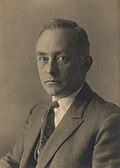 Max BornBeide ausgezeichnet mit Max Planck Medal
 Steven WeinbergBeide ausgezeichnet mit J. Robert Oppenheimer Memorial Prize
 Werner HeisenbergBeide ausgezeichnet mit Max Planck Medal
 Eugene WignerBeide ausgezeichnet mit Max Planck Medal
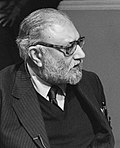 Abdus SalamBeide ausgezeichnet mit J. Robert Oppenheimer Memorial Prize
Fame.am misst Signale öffentlicher Sichtbarkeit. Es misst nicht den Wert eines Menschen, Talent, Moral oder Glaubwürdigkeit.